
Project Background
Self Help Africa (SHA) was formed in 2008 following the merger between Self Help Development International (SHDI) and Harvest Help. These two agencies had a long record of working successfully in Africa to help smallholder farmers improve their farming practices and livelihoods. SHDI has worked in Kenya since 1997, initially through Baraka Agricultural College (BAC), with a mission to develop enterprising solutions that enable smallholder farmers to achieve a better quality of life. SHA works with smallholder farmers and their families to make sustainable improvements in their livelihoods from both intensification and diversification of agriculture and greater integration into markets. As a result of its experience and learning the country programme aims to influence the policies and ways of working with other actors to enable smallholder farmers in Kenya to prosper.
Since 2005 the Country Programme has been running Area Based Programmes (ABP) in Gilgil division directly and in partnership with BAC in Kamara and Tenges division.
SHDI had been in receipt of Irish Aid funding through MAPS since 2003. During the period of MAPS I (2003 – 2006) there are many examples of change, predominantly at a local level amongst project beneficiaries. Reports and evaluations from that period also tended to focus mainly on outcomes rather than impact. So, evidence is generally in terms of increases in yield or numbers of people using improved agricultural practices or having access to basic services.
MAPS II funding (2007-2011) covered a time of change, with the merger of Self Help Development International (SHDI) with Harvest Help to form Self Help Africa (SHA), followed by a period of intense organizational development. Indeed a meta-evaluation[1] to review the outcomes of SHA’s MAPS II funded programmes noted that ‘the organization that set the targets for several of the programmes was not the same organization that now wishes to evaluate it’. Over this period there was evidence of a strong organizational learning curve. SHA used the MAPS investment to move from an organization with a range of projects in different countries to a more holistic and coherent programme approach. The SHA Strategic Plan for 2011-15 and theory of change is based on the lessons learnt from the MAPS period.
The farmers identified the following as key factors of change realized under KRDP implementation;
- Extension services offered by SHA staff , partners and collorators. The programme staff (SHA), partner (BAC) and line ministries provided timely extension services during the implementation of KRDP. However, farmers interviewed complained of inconsistency and untimely extension service provision by line Ministries, because the farmers have not embraced the government policy of demand driven service provision. They therefore still wait for the line ministries’ staff to visit them hence delay and incosistent extension services
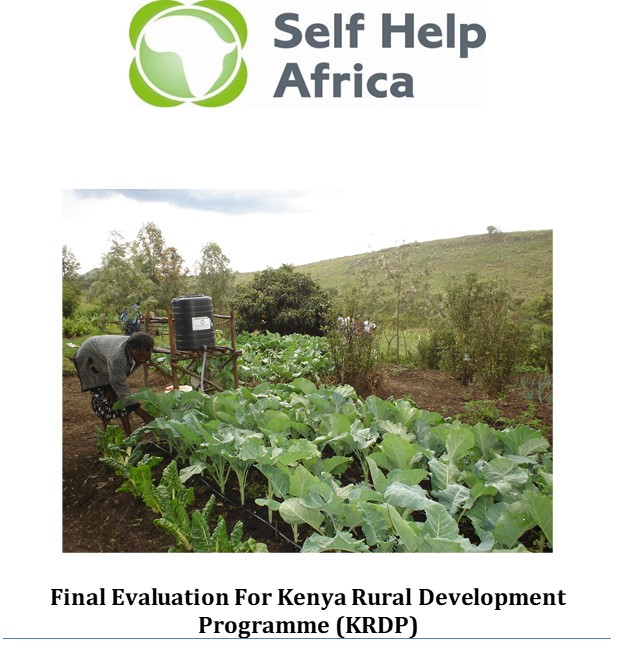
- Adequate supply of water from runoff water harvesting for farming using drip kit technology has enabled farmers to store water for upto nine months in a year thus leaving only 3 months where water for agriculture becomes a challenge.
- Farmers noted that agricultural in puts are now accessible and this has enabled them to acquire the inputs without having to travel long distances as the FAs stores have agro-vet outlets. The prices of agro-inputs is however still expensive according to farmers.
- The knowledge gained through trainings in sustainable agriculture was cited by the farmers as having been instrumental in the increase in production. The farmers are now benefiting from diversification in agricultural production having embraced the growing of DTCs and diversifying livelihoods through upgading of livestock.
- Before the programme, farmers used to use certified seeds yet most the seeds were not appropriate to their areas. With the use of appropriate certified seeds, they have now experienced increase in production.
- Farm planning and record keeping has not only helped the smallholder farmers maximixe the use of the farms but at the sametime they can now record and aportion earnings from various enterprises.
- Proper establishment of nurseries especially in agro forestry and horticulture. Farmers interviewed said they were able to integrate growing of fruits and woodlots within their farms. They noted that the types of trees grown integrated well with their crops and they can get fruits both for nutrition supplement and income a part from wood fuel.
- Duration: February 2012
[1] CIDT, 2011 Evaluation of Self Help Africa’s Multi-Annual programme Scheme (MAPS II 2007-2011)